Home bakers struggle with their baked good prices. They’re always afraid it’s “too much.”
When you only baked for family, friends, and co-workers, you only had to consider the cost of ingredients. You didn’t have to think about labeling, packaging, insurance, fees, and labor.
And neither do those judgmental customers who scoff, “this much for a cookie?”
Like, yes? But, also no.
I’m going to tell you how I stopped getting pushback on my baked good prices.
This blog post may include affiliate links, which means I may earn a commission if you make a purchase through these links, at no additional cost to you. Your trust is invaluable to me, and I only recommend products that I genuinely believe will benefit you and would personally buy or have bought myself!
Whether or not I earn a commission, these are products I would still recommend. With your support, I’m able to provide you with free information on my blog that is helpful to you.
Things to Consider
Where you are and who you serve are major qualitative factors to consider.
Although I live in Southern Maryland where it’s pretty farm-y, it’s close to Washington DC so a lot of commuters live near me, meaning prices are driven up.
As background, I sell my 2.0 ounce baked goods for $4 and 3.5 ounce chunky cookies for $6. I recently heard that New York City bakeries have been charging up to $8 for a cookie! So, big city (even being an hour away from one) means big prices.
Conversely, I have heard from home bakers in smaller towns say that there’s no way they could sell a cookie for more than $2 simply because of their economy.
So, there’s definitely nuance.
I created a spreadsheet that helped me price my baked goods. It considers the cost of goods, packaging, and labor and is a great start to ensuring that you will make enough to sustain a business.
Now, onto the good stuff.
Do We Have a Deal?
When I first started selling at the farmers market, I didn’t offer any deals. And for the most part, it didn’t stop people from buying, especially if they were in a big family.
To try boost sales, the first deal I started offering was “Buy 5, Get 1 Free” so you could get 6 cookies for $30, making each cookie $5 each instead of $6.
And no one really took it lol.
I tried marketing that you can freeze these cookies, but for the most part, it’s really hard to convince someone to go from two to 6 cookies.
That’s when I decided to offer a gift with purchase. The first item was a mini lemon loaf valued at $4.
When I began implementing this, I didn’t offer it for individual sale at all. But, the non-cookie items started to become popular, so I expanded my product line-up to include classic cookies at 2 ounces and assorted baked goods for $4.
And if you bought three $6 chunky cookies, then you’d get any $4 item for free.
It was then easier to convince someone buying only 2 cookies to get another one plus a little snack-y snack since it’s a $10 value for only $6 more.
That pushed a lot more product and successful upsells!
Comparison is the thief of… uncertainty
On one of my last days at the farmers market in 2025, a man came up to me to buy just one cookie and acknowledged that $6 is a bit steep (this was after I had implemented the deals), but really wanted something sweet to hold him over.
I pointed him towards the $4 items I had at the time, which were my 2 ounce ginger molasses cookies and hot cocoa cookies. But, then he pushed back on me saying that, “well, these [$6 cookies] seem like a better bang for my buck.”
And it’s like… THAT’S THE POINT! LOL
Having something to compare at your table gives customers something to anchor and make their decision on. People love feeling like they have choice and power.
I know at this point, you may be thinking that they’ll give you the “I’ll come back after I look around” so they can find a cheaper baker.
And they might! They might.
But, you’re also going to have customers who come back, knowing that there are cheaper bakers, because they love your stuff.
Show! Don’t Tell.
Back when I learned how to write essays, it was drilled in that you have to state the obvious because you can never assume that the reader knows what you’re talking about.
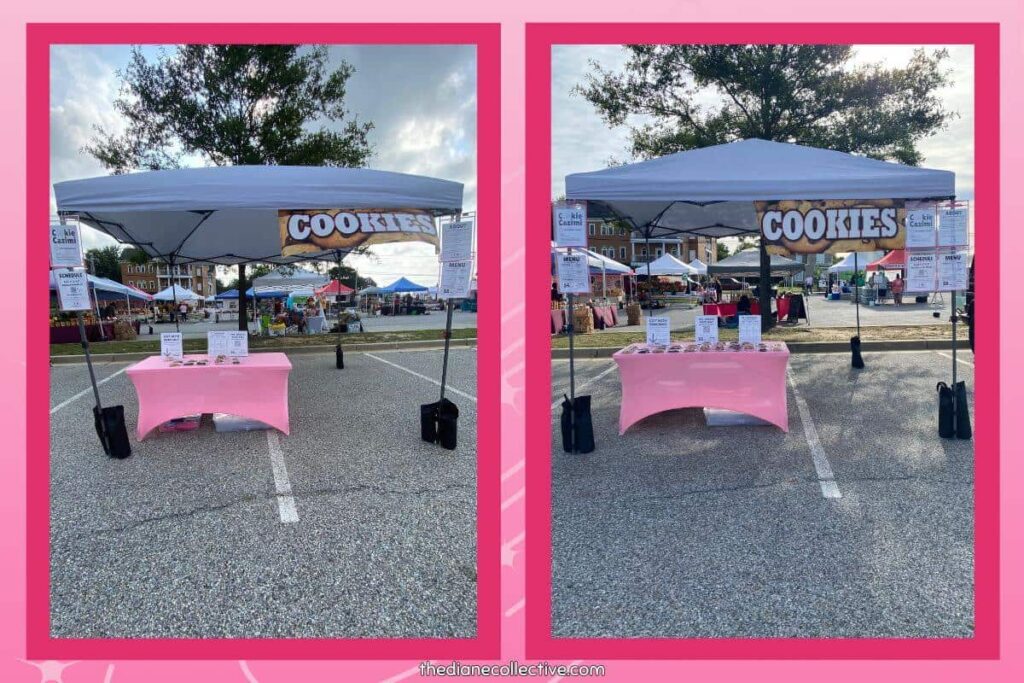
For my tent set-up, I tie these dry-erase pocket sleeves (affiliate link) with marketing material to formally introduce my home bakery and products to passerbys.
People don’t like being surveilled or harped on. They just want to look. And I simply make it easy for them to stand in front of my tent without the threat of me talking to them, haha.
I explain the meaning of my business name, the ingredients I’ve chosen to use, and the flavors I offer.
If you don’t tell your customers that Cookie Cazimi is about celebration, good luck, and opportunity or that you use high-quality, premium ingredients or that your chunky cookies use more butter than other chunky cookies for better flavor, then they’re not going to understand why they should buy from you at all.
They want to have a sense of your expertise before experiencing it. Generally, people know that home bakers love baking. But, then what? Why not go to another stand?
I highly encourage you to write some stuff up and hang up signs! They’re really effective.
What if it doesn’t clock?
The latest Justin Bieber meme plays through my head a lot.
The pop singer is confronting paparazzi for stalking him (because they are) and says, “You don’t get it. It’s not clocking to you. It’s not clocking to you that I’m standing on business, is it?”
I think it went viral because the statement doesn’t really make sense. But, I think that added to the memorability.
Basically, he’s saying that they just don’t understand and never will.
And sometimes, that’s just what it is. There will be people who simply won’t be your customers.
That’s not a sign to lower your prices. Let them go.
There’s a saying in marketing that if you’re selling to everybody, then you’re selling to nobody. Because if you’re blanketing details over, no one feels like they’re being talked to.
What if I had tried to talk to anyone who sells things in this blog post? The title would be: How to charge “too much” for your product
I don’t even know what that means. Does that mean to try rip people off?
You’ll see it all the time in home baker forums: “I’m worried I’m charging too much.”
That’s why the current title is the current title. It’s something I’ve grappled with as a home baker. I was nervous being the only baker charging $6.
But guess what? Within a few months, I noticed other home bakers charging $6-7 for their baked goods.
And I don’t think it’s because they realize they can “get away with it” and pocket extra cash. I think they felt the financial squeeze of undercharging out of fear. Because it costs more than just ingredients to run a home bakery.
I also think they saw that my prices didn’t stop customers coming to my booth after checking everyone else out.
Because I’m not selling anything but an experience and my passion.
Selling Your Baked Good Prices Conclusion
As you can see, your baked good prices aren’t really about the baked good itself.
I mean a bag is a bag, yet some are $5 and others are $50,000. Similarly, a cookie is a cookie but people like the ones from home bakers.
People want that sense of connection from you to your product.
Usually the batches are small, which usually signaling higher level of care compared to that from a factory or commercial bakery. Yes, food scientists and pastry chefs may have more education and technical know-how (and yeah, they can be home bakers as well) but they’re human; they can’t look over 10,000 cookies better than they can 10.
I hope this has been helpful for you.
NOT SURE WHAT TO BAKE?
Check out the Recipe Library to see what other bakes you can make in over 25 baking pan sizes!